Why Teaching Emotion Regulation Matters for Children in High-Conflict Divorce
Parenting Through ACEs: Resilience Skills Series offers trauma-informed, practical guidance for parents raising children affected by adversity, high-conflict co-parenting, and toxic stress, with weekly tools to build safety, regulation, and resilience at home.
When co-parenting conflict keeps showing up in your child’s world, big emotions are not a sign that they are “bad,” manipulative, or failing to cope. They are often an understandable response to stress, uncertainty, divided loyalties, transitions, and the emotional intensity around them.
Teaching children emotion regulation gives them practical ways to notice, name, and handle strong feelings without becoming overwhelmed or reacting in ways that create more problems. In a high-conflict divorce, these skills can become an important source of steadiness. Children cannot control adult conflict, but they can gradually learn what to do with the feelings it brings up.
Ongoing parental conflict is associated with greater risk of emotional, behavioral, and social difficulties for children. At the same time, many children adjust well after divorce when they have stability, support, and protection from adult conflict. Emotion regulation is not a substitute for adults reducing conflict and protecting children from it. It is one meaningful part of helping children feel safer, more understood, and more capable.
What Emotion Regulation Really Means
Emotion regulation is the ability to notice an emotion, understand what it may be communicating, recognize how intense it feels, and choose a helpful next step. It does not mean children should suppress feelings, stay cheerful, or stop reacting to genuinely difficult circumstances.
In simple terms, children need to learn:
All feelings are allowed.
Feelings give us information.
Feelings and behaviors are different things.
Big feelings can make helpful choices harder.
They can use skills to calm a feeling that is too intense or gently increase their energy when they feel shut down, low, or disconnected.
They can pause and choose what to do next instead of letting a feeling make every decision for them.
This distinction is especially important in high-conflict co-parenting situations. A child may feel furious after hearing one parent criticize the other. They may feel anxious before a parenting-time exchange, sad after returning home, or guilty because they love both parents. None of those feelings are wrong.
But if a child believes, “I am bad because I am angry,” or “I should not feel sad because it will upset Mom,” they may hide their feelings until those emotions come out through meltdowns, aggression, withdrawal, stomachaches, sleep problems, or conflict at school.
Here’s what to know: a child can feel angry and still need help not to hit. They can feel worried and still be supported in going to school. They can feel sad and still complete one small part of their bedtime routine. The feeling deserves connection; unsafe or hurtful behavior may still need guidance.
Why High-Conflict Divorce Can Overwhelm Children
High-conflict divorce can place children in emotionally complicated situations they did not choose and cannot solve. They may feel tense before transitions, listen closely for adult moods, worry about saying the “wrong” thing, or feel pressured—directly or indirectly—to take sides.
Children may also have reactions that seem much bigger than the immediate problem. For example, a child may burst into tears over a missing sock when it is time to pack for the other parent’s home. The sock is often not the whole issue. The child may already be carrying worry, sadness, anger, or uncertainty about the transition.
That does not mean the child is being dramatic. It may mean their emotional volume is already turned up.
Rather than saying, “This is not a big deal,” try to understand the message underneath the behavior:
“This feels really big right now. I wonder if there is more going on than the sock. You do not have to explain everything, but I am here with you.”
Calm, responsive relationships with caring adults help children build self-regulation over time. This supportive process is often called co-regulation: the adult offers steadiness, connection, structure, and coaching while the child is overwhelmed, so the child can gradually use those skills more independently.
Build Emotional Vocabulary
Children cannot easily manage feelings they do not have words for. Many children know “mad,” “sad,” and “happy,” but children coping with high-conflict family stress often need language that is more specific.
Useful feeling words include:
Worried
Nervous
Frustrated
Disappointed
Confused
Embarrassed
Left out
Lonely
Guilty
Jealous
Overwhelmed
Relieved
Hopeful
Use emotion words naturally, without turning every conversation into a lesson. You might name emotions in books, shows, or everyday moments:
“That character seems disappointed. They were really hoping the plan would work.”
“I noticed your shoulders got tight when the schedule changed. I wonder if you felt worried or frustrated.”
Then leave room for the child to correct you:
“Did I get that right, or is it a different feeling?”
The goal is not perfect emotional labeling. It is helping children become curious about what is happening inside them—and showing them that their inner experience can be discussed safely.
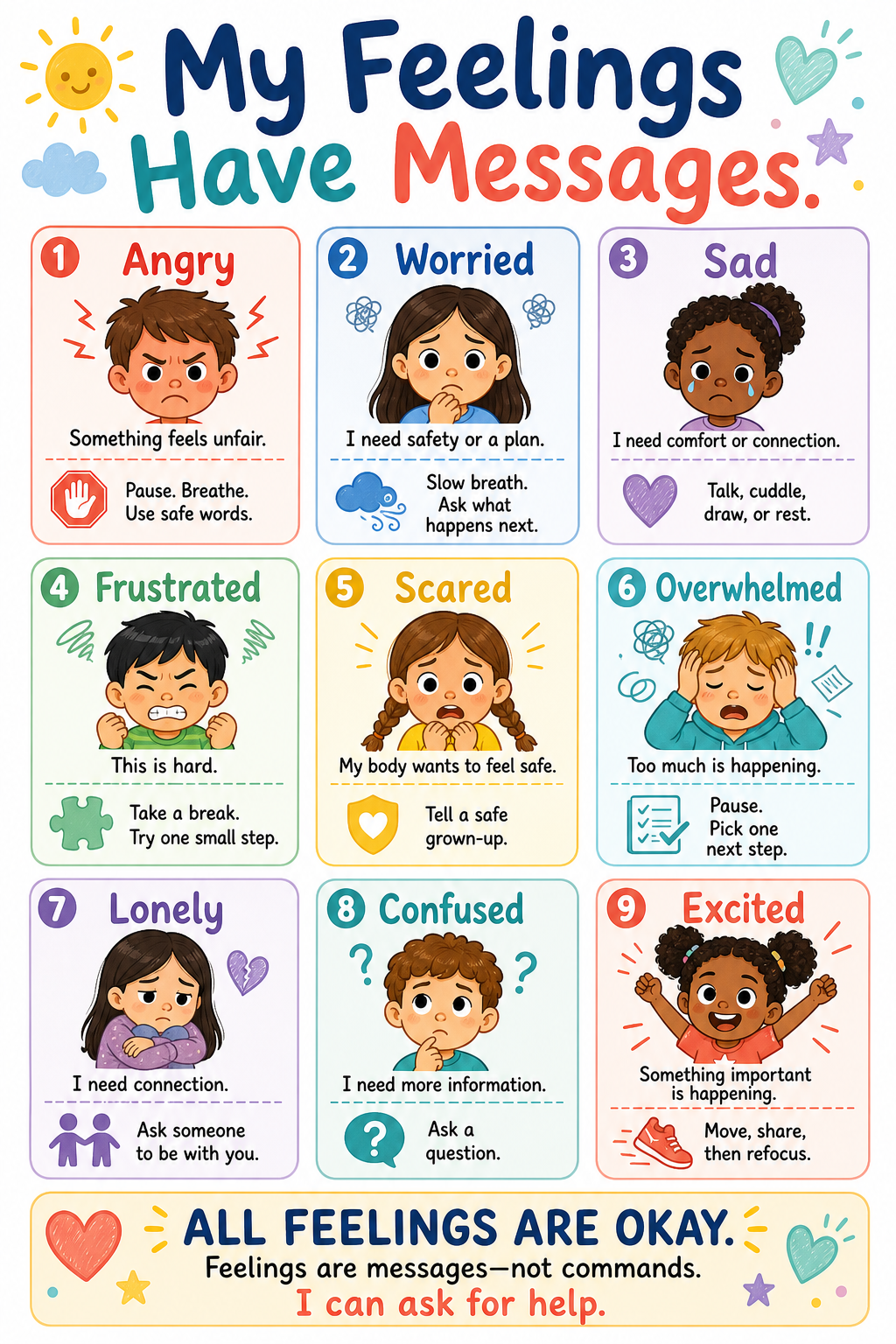
Use a Feelings Poster
A feelings poster gives children a concrete, low-pressure way to identify what they may be experiencing. It can be especially helpful for children who become quiet, defensive, embarrassed, or overwhelmed when asked directly, “How do you feel?”
Use the poster during a neutral moment: while reading together, after a movie, during a bedtime check-in, or before a predictable transition. Rather than expecting a child to explain everything, offer a simple choice:
“Which feeling on the poster is closest to how you felt when the plan changed today?”
“Was it more worry, disappointment, or frustration?”
“I noticed your body got very quiet. Is there a feeling on the poster that fits?”
A poster is not a test. It is an invitation. Your child can point, choose more than one feeling, say, “I don’t know,” or come back to it later.
Why Some Feelings May Feel Scary
Children who have witnessed intense emotional reactions from caregivers may learn to associate sadness, anger, worry, or frustration with danger. If angry voices, crying, blame, threats, intimidation, withdrawal, or unpredictable adult reactions have been part of their experience, they may begin to experience emotions as warning signs that something bad is about to happen.
As a result, a child may become defensive when they notice a caregiver is frustrated. They may shut down when someone is sad, become highly anxious when another person looks worried, or deny their own feelings altogether. A child might say, “I’m fine,” while crying, hiding, becoming irritable, or refusing to talk.
This does not necessarily mean the child is being dishonest, defiant, or unwilling to connect. It may mean that acknowledging emotion feels unsafe.
In a high-conflict co-parenting situation, this may look like:
A child becoming panicked when a parent’s tone changes slightly.
A child trying to make a sad parent feel better rather than expressing their own needs.
A child becoming angry or argumentative when asked about difficult feelings.
A child denying worry before a parenting-time exchange, then experiencing stomachaches, sleep problems, tears, or a meltdown.
A child withdrawing because they fear that sharing a feeling will lead to adult conflict, disappointment, interrogation, or pressure to take sides.
A helpful response is to make emotions predictable, allowed, and separate from behavior. You might say:
“You are not in trouble for having a feeling. Feelings are messages from our body and brain. We can notice them without having to act on them right away.”
“It is okay to be angry. It is not okay to hurt someone or break things. Let’s find a safe way to help the anger.”
“You do not have to talk before you are ready. I want you to know you can always tell me if something feels sad, scary, confusing, or too big.”
“I feel frustrated, but I am still safe. I am going to take a breath and talk to you calmly.”
Children learn emotional safety not only from reassurance, but also from repeatedly seeing adults have feelings without exploding, blaming, threatening, or withdrawing. Warm, responsive support from caring adults helps children gradually develop their own capacity for self-regulation.
A feelings poster is more than an activity. It can become a quiet, consistent reminder that every emotion is allowed, that no feeling makes a child “bad,” and that difficult feelings can be met with support rather than fear.
Try This With Your Child
Use the feelings poster during a calm moment—not only during a meltdown or difficult transition. Invite your child to point to the feeling that fits, talk about what the feeling may be communicating, and choose one small way to help their body feel more settled.
Keep the poster somewhere your child can easily access, such as a bedroom, homework area, family check-in space, or calm-down corner. The goal is not to make difficult feelings disappear. It is to help your child recognize that feelings are allowed, understandable, and manageable with support.
Teach Children to Notice Emotional Intensity
Emotion regulation is not only about identifying a feeling. It is also about recognizing how intense it is.
A preschooler might describe a feeling as little, medium, or big. A child around ages 5–8 may use a 1–5 scale. Older children and teens can often use a 1–10 scale.
For example:
“How big is your worry about tomorrow’s transition right now—more like a 3, a 6, or a 9?”
This gives children a way to communicate even when they do not want—or cannot yet—explain the full story. It also helps them learn that when an emotion is very intense, it can be harder to think clearly, solve problems, or communicate respectfully.
You can explain it this way: feelings are useful signals. Anger may tell us something feels unfair. Worry may tell us we need information or reassurance. Sadness may tell us we miss someone or need comfort. But when a feeling becomes much bigger than the immediate problem, it can begin making choices for us.
For example, when a sibling knocks down a block tower, anger makes sense. But if the child hits, throws blocks, or says hurtful things, the anger is now directing behavior. The goal is not to get rid of anger; it is to help the child respond to it safely.
First, help lower the emotional intensity. Then help the child choose a response:
“I am angry. Please do not knock down my tower.”
“I need help.”
“I am going to take a break until I am calmer.”
For children in high-conflict divorce, this is a valuable skill. They may not be able to change a schedule, reduce adult conflict, or control co-parenting decisions. But they can learn to recognize, “My feeling is at an 8. I need a regulating skill before I yell, shut down, assume the worst, or say something I regret.”
Build a Practical Emotion Regulation Toolbox
Children learn emotion regulation best when skills are practiced during calm moments—not introduced for the first time in the middle of a meltdown, transition, or argument.
Create a simple calm-down toolbox together. Let your child experiment and identify which tools genuinely help. There is no single strategy that works for every child or every feeling.
For Worry, Anger, and High Emotional Energy
When a child feels anxious, angry, agitated, or caught in racing thoughts, calming tools can help reduce emotional intensity.
Try:
Slow belly breathing, with a longer exhale than inhale
“Smell the flower, blow out the candle” breathing
Tracing a square, figure eight, or another shape while breathing slowly
Progressive muscle relaxation: squeeze a muscle group, then let it soften
Gentle yoga, stretching, or slow body movement
Splashing cool water on the face
Listening to calming music
Drawing or writing about the feeling
Taking a short, supervised break from the situation
Grounding through the senses: name five things you can see, four you can feel, three you can hear, two you can smell, and one you can taste
Avoid saying only, “Take a breath.” Many children interpret that as taking one large, quick, shallow breath, which may not feel calming. Teach the skill clearly when your child is settled:
“Put one hand on your chest and one on your belly. Let’s breathe slowly enough that the hand on your belly moves.”
For Sadness and Low Emotional Energy
When a child is sad, withdrawn, or low-energy, connection often comes before problem-solving. Their sadness may need company and acknowledgment before they are ready to move into another activity.
Try:
Sitting nearby without requiring them to talk
Offering a hug, back rub, rocking, or comfort item if welcomed
Reflecting what you notice: “You really miss the way things used to be”
Inviting them to draw, write, or talk when ready
Taking a gentle walk or doing quiet movement together
Using play, humor, or a familiar shared activity after the child feels heard
You do not need to make the feeling disappear. Sometimes the most supportive message is:
“You can miss your other parent while you are here with me. Both things can be true.”
That statement helps reduce the loyalty bind many children feel after separation.
Use Connection Before Correction
When a child is dysregulated, begin by connecting with the emotion before addressing the behavior. Validation does not mean agreeing with every interpretation or allowing hurtful actions. It means showing the child that you understand their experience enough to help them regain control.
Instead of: “Stop crying. You are fine.”
Try saying:
“You are really upset. Something about this feels hard.”
Instead of: “Do not talk to me like that.”
Try saying:
“I can hear you are angry. I will listen when your voice is safer. Let’s help your body calm down first.”
Instead of: “You always have a problem when it is time to go.”
Try saying:
“Transitions can bring up a lot. You do not have to choose between loving both of your parents. Let’s focus on the next ten minutes.”
A simple sequence can guide you:
Regulate yourself first.
Notice and name what the child may be feeling.
Validate the feeling.
Set a calm, clear limit when needed.
Offer a coping tool or a choice.
Return to problem-solving after the child is calmer.
Adults do not need to be perfectly calm. Repair matters. If you raise your voice or respond in a way you regret, model responsibility:
“I was frustrated, and I raised my voice. That was not how I wanted to handle it. I am going to calm my body, and then I will try again.”
Use ownership language rather than blame. Instead of, “You make me so frustrated,” say:
“I feel frustrated when I have to repeat myself. I am going to take a breath and tell you what needs to happen next.”
Help Children Identify Their Triggers
A trigger is not an excuse for unsafe behavior. It is information about when a child may need more preparation, structure, or support.
For children navigating high-conflict co-parenting, common triggers may include:
Parenting-time exchanges
Schedule changes and uncertainty
Packing bags or forgetting important items
Feeling rushed
Changes in homes, routines, rules, or expectations
Hearing adults argue, criticize one another, or discuss legal matters
Being asked questions about the other parent
Conflict with siblings after a transition
Discuss patterns when your child is calm:
“I have noticed that the night before exchanges can feel harder. What do you notice in your body or thoughts on those nights?”
Then create a manageable plan together:
“If your worry gets to a 7, you can tell me, use your breathing card, listen to your playlist, or sit with me for five minutes. We can also pack earlier so the morning feels less rushed.”
This is not about putting children in charge of the divorce. It is about giving them support and choices in the areas of life where they do have some control.
Common Mistakes to Avoid
Treating Feelings as Misbehavior
Set limits on yelling, throwing, name-calling, or aggression when needed. Do not punish the emotion itself. When children learn that anger, sadness, or worry is unacceptable, they may become ashamed or less likely to seek help.
Asking Children to Manage Adult Emotions
Avoid statements such as, “Do not tell Dad I am upset,” “You need to be strong for me,” or “I cannot handle hearing about Mom right now.” Children should not have to protect either parent emotionally.
Pressuring Children to Choose Sides
Children can love both parents, be upset with both parents, miss one parent while with the other, and hold complicated feelings at the same time. Make room for that complexity without asking them to defend, report on, or reject either parent.
Teaching Skills Only During a Crisis
When a child’s body is in alarm, it is harder for them to access the thinking and learning parts of the brain. Practice emotional vocabulary, breathing, grounding, and calming routines during ordinary moments so the skills are familiar when they are needed.
Expecting More Than Development Allows
Emotion regulation develops gradually. Children need repetition, adult modeling, structure, and many opportunities to practice. A struggle to regulate is often a sign that a child needs greater support or a different tool—not proof that they are defiant or incapable.
A Child-Centered Path Forward
Teaching emotion regulation is not about asking children to quietly adjust to conflict that adults should reduce. It is about offering language for their experience, permission to feel what they feel, and practical ways to get through difficult moments without carrying adult responsibility.
The most helpful message is not, “You need to calm down.” It is:
“Your feelings make sense. You are not alone with them. We can help your body settle, and then we can decide what to do.”
With repeated support, children can learn that strong feelings are temporary, manageable, and not something they have to face alone. They can learn to pause, ask for help, and make choices that protect their relationships, learning, and sense of self.